
The Cause They Abandoned
How Afghanistan's women disappeared from the West's moral imagination
In 2008, I deployed to Afghanistan as an intelligence officer on a Provincial Reconstruction Team responsible for Parwan and Kapisa Provinces. Although my official job was intelligence, I often found myself moonlighting as a Civil Affairs officer, helping launch quick impact projects throughout Kapisa Province. We repaired mosques, dug wells, funded schools, and tackled dozens of small projects that were intended to improve everyday life for ordinary Afghans.
It was during that deployment that I met the army of aid workers who had descended on Afghanistan. They came from USAID, the United Nations, and a host of international NGOs. Most leaned left politically, although that mattered very little to me at the time. What mattered was that they believed deeply in what they were doing. Whenever I asked why they had volunteered to spend years of their lives in one of the most dangerous places on earth, the answer was remarkably consistent.
They were there to help Afghan women.
I never questioned their motives because I agreed with them. After years in Iraq and Afghanistan, I had seen enough cruelty to understand what Taliban rule meant for women. They had been denied an education, excluded from public life, and treated as little more than property. If there was one genuinely noble objective of America’s longest war, it was giving Afghan women an opportunity to build lives their mothers and grandmothers had never been allowed to imagine.
Over the next three deployments, I watched that vision slowly become reality.
Progress was uneven, frustrating, and often painfully slow, but it was real. Girls filled classrooms that had once been empty. Women entered universities. They became doctors, lawyers, journalists, professors, entrepreneurs, police officers, prosecutors, and members of Parliament. They joined the Afghan National Defense and Security Forces and began serving their country in ways that would have been unimaginable under the Taliban.
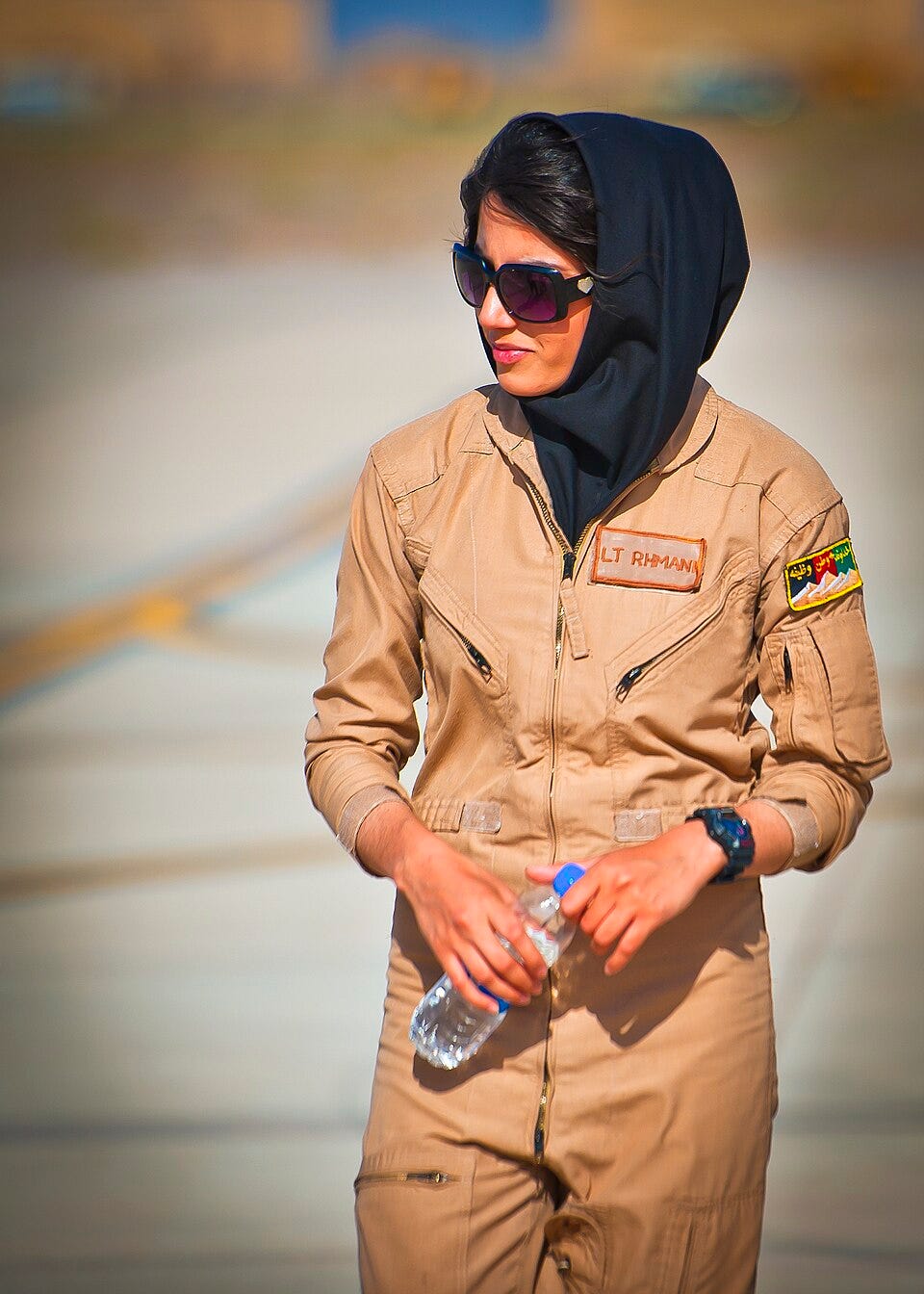
During my final deployment, I met a female squadron commander in the Afghan Air Force. She had overcome extraordinary obstacles to become a combat pilot. Watching her brief missions and command her squadron, it was difficult to reconcile what I saw with the Afghanistan I had first encountered years earlier. She represented something much larger than her own accomplishments. She embodied the extraordinary transformation that had taken place over two decades.
The statistics confirmed what many of us witnessed firsthand. According to the Asia Foundation’s 2019 Survey of the Afghan People, nearly 90 percent of Afghans believed women should be allowed to vote. More women were attending universities than at any point in Afghan history. Women served in government ministries, provincial governments, the judiciary, and the military. Even during America’s final months in Afghanistan, coalition advisors continued encouraging the Afghan government to recruit more women into the security forces. Afghan female commandos served shona ba shona, shoulder to shoulder with their male counterparts, conducting raids while ensuring Afghan women were treated with cultural dignity during searches and interrogations. President Ashraf Ghani even directed every province to appoint a female deputy governor so that women’s concerns would remain represented at the provincial level.
None of this meant Afghanistan had become a thriving liberal democracy. Corruption remained endemic. Security deteriorated in many rural areas. The Taliban still controlled significant territory. Progress was fragile, and everyone who served there understood that.
But progress nevertheless existed.
Whatever history ultimately concludes about America’s twenty-year war, Afghan women were among its greatest beneficiaries, alongside Afghanistan’s ethnic and religious minorities. Millions of women experienced freedoms that simply had not existed before 2001. That achievement deserves to be remembered even by those who believe the broader war was a strategic failure.
Much of the political momentum behind that effort came from Democrats. Hillary Rodham Clinton made advancing the rights of Afghan women a central feature of American diplomacy during the Obama administration. Democratic politicians routinely cited the liberation of Afghan women as one of the strongest moral justifications for maintaining America’s presence in Afghanistan. Aid organizations echoed that message, and much of the American press embraced it. For nearly twenty years, Afghan women became one of the defining humanitarian causes of the American Left.
Then came August 2021.
President Joe Biden chose to complete the withdrawal negotiated under President Donald Trump’s Doha Agreement despite the Taliban’s repeated refusal to sever ties with al Qaeda and despite widespread concern about the Afghan government’s ability to survive without American support. Within days, provincial capitals began falling. Within weeks, the Islamic Republic of Afghanistan ceased to exist.
For Afghan women, the consequences were immediate.
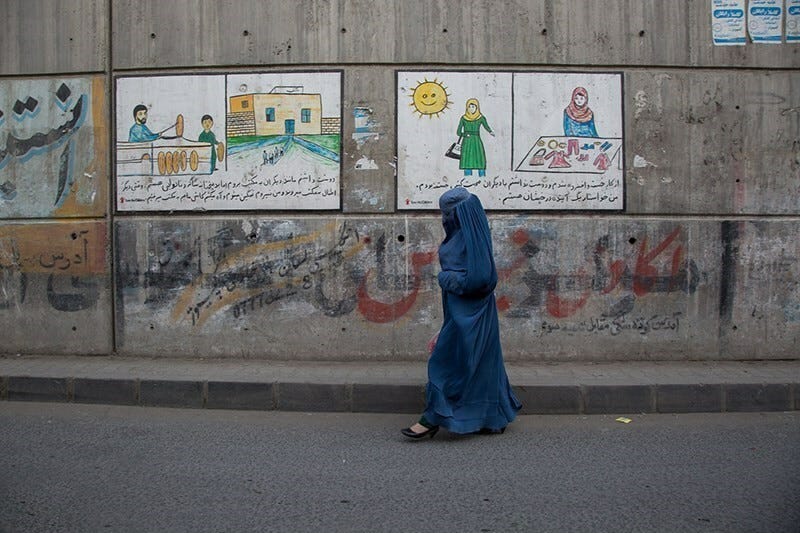
Girls were prohibited from attending school beyond the sixth grade. Universities closed their doors to women. Women were driven from most professions and public offices. They lost the freedom to travel without a male guardian. The Taliban imposed increasingly restrictive decrees governing nearly every aspect of their lives. Today, Afghan women are effectively forbidden from speaking in public. The regime has sought to silence even their voices, reducing half of Afghanistan’s population to second-class citizens while stripping them of nearly every freedom they had gained over the previous twenty years.
Twenty years of progress disappeared almost overnight.
What shocked me, however, was not simply the Taliban’s return. History is full of reversals, and anyone who served in Afghanistan knew that victory was never guaranteed. What shocked me was how quickly the cause itself disappeared from our public conversation.
The journalists who once wrote endlessly about Afghan women rarely write about them today. The activists who organized campaigns on their behalf found new causes. Politicians who had invoked Afghan women as a moral justification for American policy seldom mention them anymore. Many of the NGOs that built their reputations advocating for Afghan women understandably continue humanitarian work, but Afghanistan no longer occupies the place it once did in our moral imagination.
Instead, much of that energy has shifted elsewhere, particularly toward Israel and the war in Gaza. Many of the same commentators, activists, and public figures who once insisted Afghan women represented one of the defining human rights causes of our generation now devote extraordinary attention to accusing Israel of genocide and organizing political movements around that claim. I disagree with that characterization of Israel’s actions, but my point is not to relitigate the war in Gaza.
My point is about consistency.
The Taliban’s destruction of women’s rights is not hidden. It is not subtle. It is one of the most sweeping systems of legal discrimination against women anywhere in the world. Twenty-one million Afghan women and girls live under a regime that has systematically erased them from public life, yet their plight rarely dominates our political discourse with anything approaching the intensity that surrounded Afghanistan twenty years ago or that surrounds other international causes today.
If I were a Palestinian, I would pay close attention to Afghanistan. I would remember how quickly yesterday’s indispensable humanitarian cause became today’s forgotten tragedy. I would remember that many of the same activists, journalists, politicians, and NGOs who once promised they would never abandon Afghan women largely stopped talking about them after the Taliban returned to power. And I would wonder whether today’s loudest advocates will still be there five years from now, after the cameras have moved on and another cause has captured the world’s attention.
Political movements often speak in the language of universal principles. Sometimes they live up to those principles, and sometimes they don’t. Afghanistan offers an uncomfortable reminder that public attention is often fleeting, even when the suffering is not. The measure of a movement is not how passionately it embraces a fashionable cause. It is whether it remains committed after that cause ceases to be fashionable.
Afghan women did not stop suffering in August 2021. Their freedoms continued to disappear long after the last American aircraft departed Kabul. What changed was not their need for advocates, but our willingness to listen.
That, more than the military defeat itself, is what I have found hardest to accept. Twenty years were spent telling Afghan women that the free world stood with them. Many believed us. When their world collapsed, too many of the people who had once spoken most passionately on their behalf simply turned the page. Tragically, many of those who championed their cause, then championed Biden’s decision to abandon them as “courageous.”
And that is a betrayal from which they may never recover.
This is an excellent article- meaningful and direct. I am concerned about the future of the women of Afghanistan. I am profoundly concerned about the Moral Injury left behind for our veterans. Also, where is the deep objective review of Afghanistan and lessons learned. Maybe a report exists and I have missed it or it is only for the military. It needs to be done if not already done and made public. After 20 years of our losses--blood and treasure-- and the decades remaining for our veterans that lived that experience we are entitled to see this. Thank you for writing this.
As a veteran, this stain on our nation’s honor troubles and pains me deeply. It is a tragedy that did not need to happen. Our politicians (both democrat and republican) deliberately chose the politically expedient path. In doing so they abandoned our allies and harmed our long-term geopolitical and strategic security interests. And we as a nation let it happen.
This moral injury will haunt the U.S. for generations. However the women of Afghanistan shall suffer a far worse fate. History will not judge us kindly & rightly so. We could have made a difference (albeit however imperfect the results may have been…) that would have justified all of the blood, sweat, tears and treasure we lost in the “Graveyard of Empires.”