
Blaming the Jews for Everything
Joe Kent Just Can't Help Himself
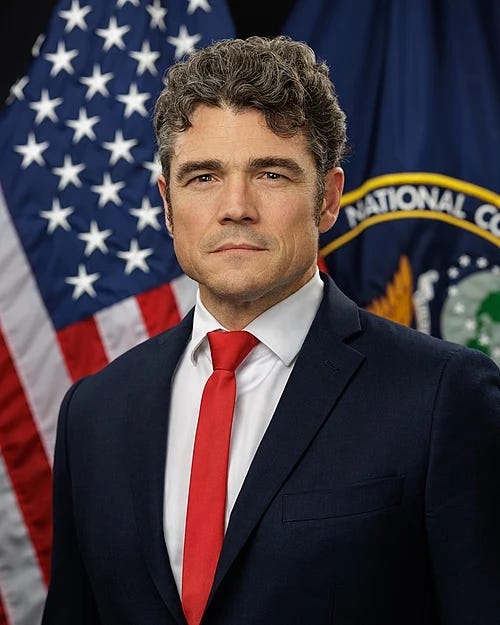
Joe Kent has officially resigned as Director of the National Counterterrorism Center over the war with Iran. On its face, that’s fine. In fact, it’s more than fine—it’s commendable. If you think a war is wrong, you shouldn’t stick around and salute smartly while it unfolds. Too many people in Washington do exactly that. Kent didn’t. Good.
Joe Kent also served honorably as a Green Beret and inside the CIA. His wife was tragically killed in Syria while serving as a Navy cryptologic analyst for Joint Special Operations Command. His family has heroically sacrificed mightily for this country, and we owe him a debt of gratitude for a lifetime of service.
That’s where the praise ends.
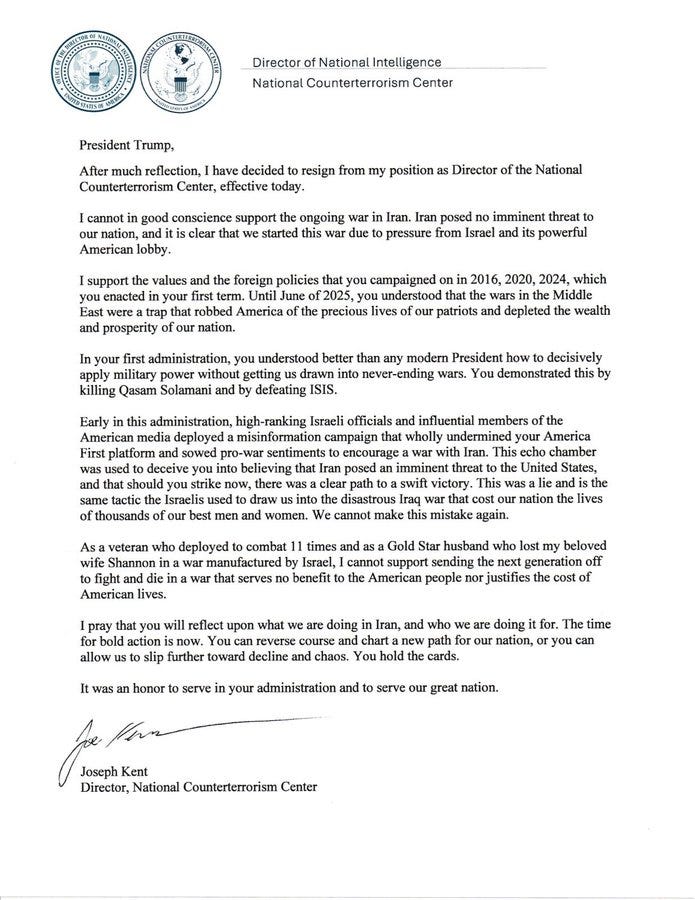
Because Kent didn’t just resign, he decided to light a match on his way out the door and blame the whole thing on Israel and “its powerful American lobby.” Not flawed assumptions. Not a disagreement over risk tolerance. No—this was apparently all driven by shadowy foreign pressure.
We’ve seen this movie before.
Let’s start with Iraq, since Kent seems eager to drag that into the conversation. The idea that Israel pulled the United States into Iraq is one of those narratives that sounds edgy until you spend five minutes actually looking at the facts. Ariel Sharon told the Bush administration to focus on Iran, not Iraq. Netanyahu did speak publicly in favor of removing Saddam—but he was a private citizen at the time, not in government. Not making decisions. Certainly not steering U.S. policy from afar like some Bond villain. The United States went into Iraq because it decided to go into Iraq. Full stop.
And Kent didn’t stop there. No, he went ahead and folded Syria into this grand conspiracy as well. Which is impressive, because it requires ignoring reality at a level that should make any serious person uncomfortable. Syria’s civil war started because Bashar al-Assad decided to butcher his own population when they protested. That’s it. That’s the origin story. From there, it spiraled—ISIS, Iran, Hezbollah, Russia, Turkish interests, Gulf money, every flavor of jihadist lunacy you can imagine. But sure, let’s just pin that on Israel too. Why not? At this point, we might as well blame them for the weather while we’re at it.
Fast forward to today.
Yes, Israel lobbies the United States on Iran. So does Saudi Arabia. So does every ally we have. That’s called foreign policy. The United States lobbies other countries constantly. Influence is not coercion. Advice is not control. And the idea that the most powerful country on earth was somehow dragged into war against its will by Israel requires a level of intellectual laziness that’s hard to take seriously.
When you start talking about “powerful lobbies” steering American war policy, you’re not breaking new ground—you’re dipping into a very old, very ugly playbook. Dressing it up in policy language doesn’t make it smarter. It just makes it more palatable for people who should know better.
And this isn’t coming out of nowhere.
Kent has spent years circling the drain of the more unsavory corners of the political ecosystem—people and movements that flirt with this kind of thinking, tolerate it, or outright embrace it. So when he drops a line like this, it doesn’t come across as some isolated moment of frustration. It looks like exactly what it is: a pattern.
Give it about five minutes, and he’ll be sitting across from Tucker Carlson, being hailed as a brave truth-teller who dared to speak out. The same ecosystem that has been pushing these narratives for years will now have a former NCTC Director to point to as validation.
And on the other side, critics of the Iran war will happily scoop him up as well. Which, to a point, is fair—dissent from inside the system matters. But it’s also a little rich. The same people who spent years rolling their eyes at Kent are now going to treat him like a credible insider because he’s saying something they agree with. Funny how that works.
Here’s the reality.
Kent may be right about the war. Maybe it’s a mistake. Maybe it’s unnecessary. Those are arguments worth having, and people can disagree in good faith.
But blaming Israel—or “the Jews,” once you strip away the polite phrasing—for American foreign policy decisions isn’t analysis. It’s a crutch. It’s lazy. And it’s been used for decades by people who don’t want to do the harder work of actually understanding how decisions get made in Washington.
Needed truth telling and perspective, thanks!
Thanks for the excellent analysis and perspective.
Missed your insightful commentary this past year--welcome back!