
Are We Winning?
Trump at a Crossroads

As the war ends its fourth week with no real end in sight, the war about the war is like walking into a married couple fighting and realizing they don’t inhabit the same universe.
For the “war triumphalist,” they correctly note that the United States and Israel have degraded Iran’s ballistic missile program, its military, and its repressive regime. Iran’s senior leaders are literally dead men walking. Mojataba Khamenei, the new Ayatollah of Rock N’ Rollah, is basically doing a Weekend at Bernie’s impersonation. Regardless of how the war ends, Iran’s ability to project military power outside its borders has been degraded. Its leadership is now increasingly concentrated in the hands of the Islamic Revolutionary Guard Corps.

For the “war doomsayers,” they correctly note that for all the warheads on foreheads, Iran retains the ability to strike Arab allies, Israel, and American bases across the region—albeit at a diminishing rate. More importantly, they point to the closure of the Strait of Hormuz and ask a very legitimate question.
So who is right? The answer: both. Who will be proven correct? That remains to be seen.
The primary difference between the two camps is over the war’s political objectives—if there are any. For the triumphalist, they point to repeated talking points by Secretary Hegseth and Rubio that disavow regime change and instead focus on dismantling Iran’s ballistic missile program, its military, its defense industry, and its repressive apparatus.
The problem of course is this.
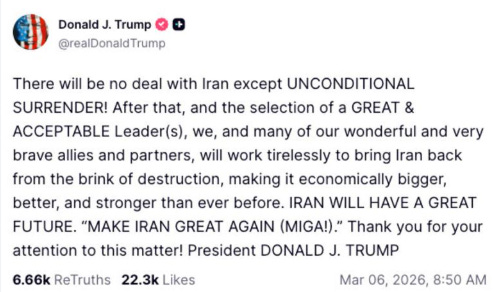
Now, war aims change. We’ve seen that in our misadventures in Mesopotamia and the Hindu Kush. However, this ain’t that. President Trump, who likes to maintain “strategic flexibility” (and that’s putting it politely), has repeatedly said the war has been won while simultaneously threatening to blow Iran’s power infrastructure to smithereens—before back tracking because of “productive talks.” That’s not flexibility. That’s incoherence.
Had the United States taken care of the Strait of Hormuz conundrum during the earliest stages of the war, I’m fairly confident that Trump and Bibi would be close to winding this little “excursion.” Instead, one of the most strategically significant choke point in the global economy remains contested. That raises an uncomfortable possibility: either we misjudged its importance, or we never had a coherent plan to secure it in the first place.
So, now Pakistan—our great wonderful ally who ensured our defeat in Afghanistan—is hosting indirect talks between the United States and Iran. And why not? They just pressed pause on their totally predictable border spat with the Taliban.

Trump reportedly sent a 15-point peace plan demanding the cessation of Iran’s nuclear program, its support for proxies, its ballistic missile program, and the reopening of the Strait of Hormuz. The Iranians, predictably, responded with their own maximalist demands: closure of U.S. bases in the region, transit fees for the Strait, guarantees the war won’t restart, retention of their missile program, and the lifting of all sanctions.

A country on the brink of defeat doesn’t usually negotiate like that.
So how does all this end?
Strip away the rhetoric, and there are really only three plausible outcomes.
First, Trump unilaterally calls it quits, declares a bigly victory, and leaves Israel to figure out the rest. We’ve seen this movie before. Earlier in Trump 2.0, the United States launched an air campaign against the Houthis in Yemen with great fanfare, only for Trump to declare victory when the Houthis refused to fold—leaving Israel surprised and adversaries unconvinced.
Trump escalates. That could mean targeting Kharg Island to choke off Iran’s oil exports or attempting to seize or destroy enrichment material. It would likely involve a concerted effort to reopen the Strait via minesweepers and naval escorts. Iran would respond asymmetrically—attacking regional energy infrastructure and possibly unleashing the Houthis to shut down the Red Sea. They’ve been suspiciously quiet so far, which should concern everyone.
We drift back to a modified status quo. Some sanctions get eased, the Strait reopens, Iran offers vague assurances about dialing back its nuclear and missile programs, and everyone pretends something meaningful was accomplished—despite the underlying dynamics remaining largely intact, save for a weakened Iranian military.
So what will happen? My bet is escalation followed by some version of the third outcome. But if that escalation produces significant American casualties, the first option becomes far more likely.
Anybody who says they know how this ends is selling snake oil. This war is too fluid, too politically unmoored, and too strategically ambiguous to call with any confidence.
As always you wade through the chaos and make it easier to understand. Thanks for the review and assessment.
Will, I’m sorry that I am not seeing more comment on this. You make some really important points; and having read your pieces for a long while, I deeply appreciate your perspective. I suspect there may some deep sympathies for absolutely wrecking Iran. And that makes sense.
Absolutely horrible regime.
And yet, are we really OK with the current President ducking and weaving and sending more people to die in a war- or special operation, or excursion- that only results in more deaths for Americans? With *No* stated goal?
I guess it’s all fine. DJT and his fam and friends make big bucks, and we sacrifice a few more ‘suckers and losers’. Sorry, not fine with me.