
A Time for Choosing
Why American Zionist Should Draw a Line
Howdy,
I’m not much of a Democrat. Before the 2024 presidential election, I described myself as a Liz Cheney Democrat. By that, I mean I’m pro-life, pro-Second Amendment, pro-NATO, pro-Ukraine, and pro-Israel.
That probably makes up about 0.0001% of the Democratic Party.
I’ve also said before that once the Republican Party nominates someone who isn’t part of the America First movement, I’ll probably head right back home. Consider this truth in advertising.
Nevertheless, I’ve watched with growing concern as a vocal anti-Israel faction has become increasingly influential within the Democratic coalition.
Wait, what do you say?
“C’mon, Will. It’s not anti-Israel to criticize Israel.”
Of course it isn’t.
I could write an entire article criticizing Israel. The settler movement deserves criticism. Bezalel Smotrich and Itamar Ben-Gvir are grotesque figures. Benjamin Netanyahu is often his own worst political enemy. Like every military engaged in a long and brutal war, Israel has made mistakes in Gaza.
Reasonable people can debate all of that.
But when I see rhetoric like this on X, you’ll have to spare me the lecture.
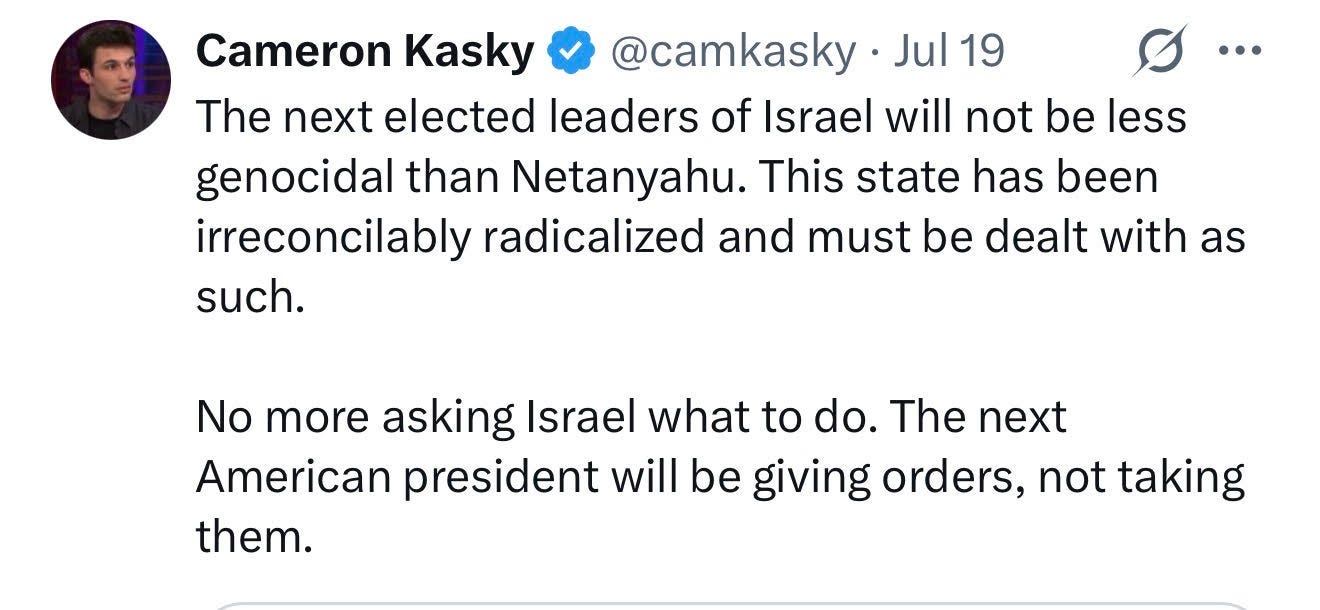
Cameron Kasky is an ignoramus whose understanding of the Middle East is about as sophisticated as my understanding of macroeconomics: superficial and full of clichés.
It’s remarkable how much attention he receives. Other than surviving the Parkland shooting and being Jewish (cue, the “As a Jew” pheonomenon), he has little expertise on the Middle East.
Yet here he is declaring that Israelis are beyond hope and “must be dealt with as such.”
What exactly does that mean?
What should be done with Israelis?
Are every one of Israel’s politicians genocidal? Even those on the Israeli left?
The fact that people this uninformed are routinely presented as authorities on one of the world’s most complicated conflicts is depressing.
Then there’s his declaration that “the next American president will be giving orders, not taking them.”
Please.
If Benjamin Netanyahu were actually pulling Donald Trump’s strings, we’d probably have seen a Kurdish ground invasion of Iran followed by an attempt to reinstall—check notes—Mahmoud Ahmadinejad.
Trump routinely mocks Netanyahu. That’s a strange way to treat someone who supposedly controls American foreign policy.
I single out Kasky because he’s emblematic of a broader trend.
There is a strain within today’s Democratic coalition that has moved well beyond criticizing Israeli policy. It increasingly portrays Israel itself as uniquely illegitimate and treats nearly every Zionist as morally suspect.
Hasan Piker is perhaps the best-known example. The nephew of Cenk Uygur, he praises Mao while wearing Mao jackets and routinely sanitizes Hamas—a terrorist organization that murdered scores of Americans on October 7.
Or perhaps we can go with New York City Mayor Zohran Mamdani, whose wife couldn’t help but like tweets celebrating the October 7 Hamas attacks, and who himself released an Orwellian two-minute hate-filled video that was so over the top that even the New York Times’ Thomas Friedman was essentially saying, “Take it easy there, Mr. Hegel.”
Is it any wonder that attacks targeting Jews have increased during Mr. Mamdani’s tenure?
I could go on and on.
To some extent, I understand where much of this anger comes from.
The war with Iran was what political scientists refer to as a cluster-fuck. Many on the left blame Netanyahu. Others remain furious that progressive candidates have repeatedly lost internal Democratic battles to more establishment figures.
American progressivism has a long and distinguished history. From William Jennings Bryan to Ralph Nader, progressives have always been part of our political tradition. They’ve never been my cup of tea, but they’re unquestionably part of America’s political fabric.
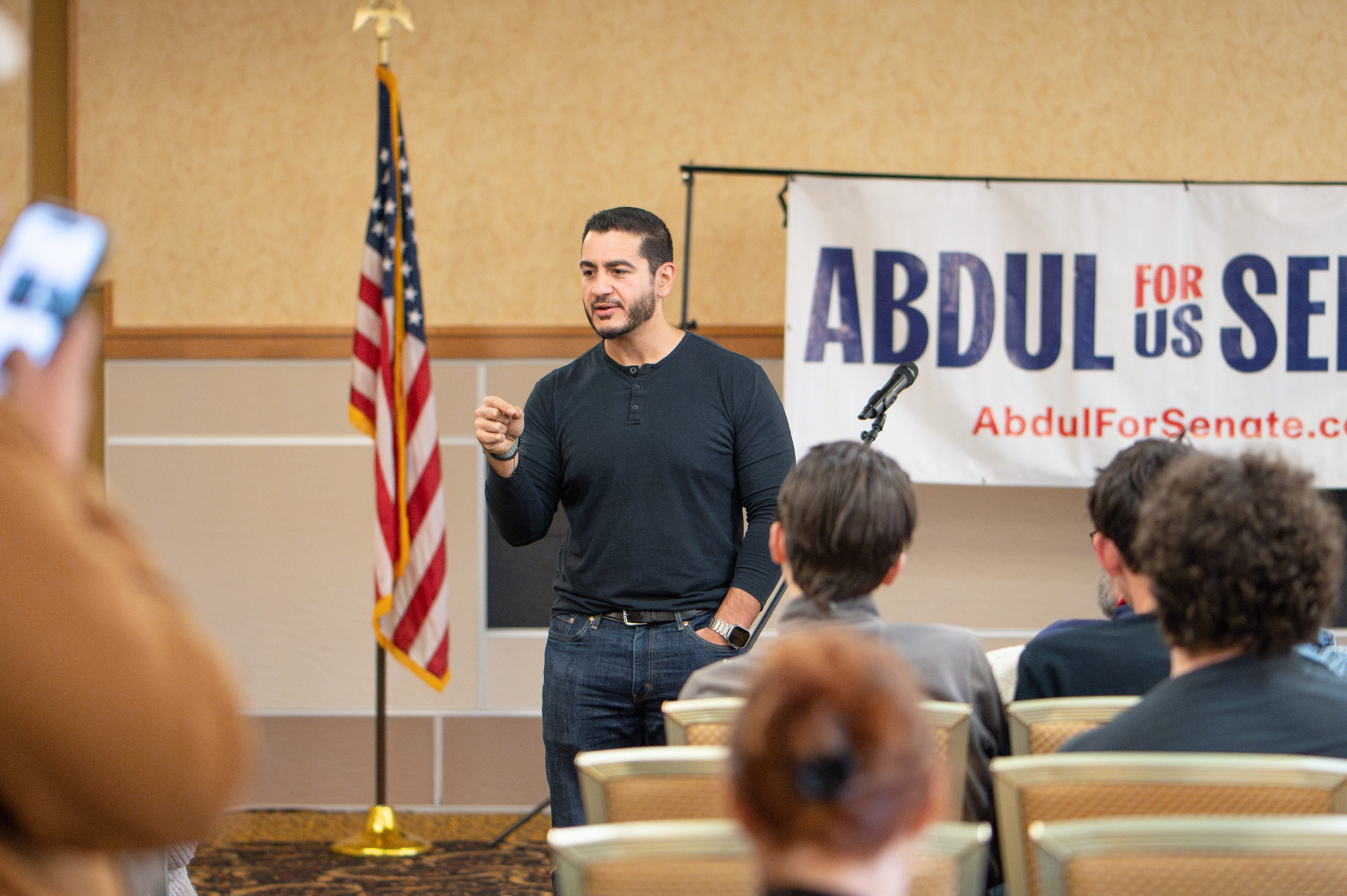
Which brings us to Abdul El-Sayed.
His Democratic primary victory is historic. Many Muslim Americans have every reason to celebrate. Becoming the first Muslim nominee of a major party for the United States Senate is a genuine milestone.
But historic firsts do not exempt candidates from scrutiny.
Because criticism of Muslim politicians is so often dismissed as Islamophobia, I’ll simply lay out the facts and let readers reach their own conclusions. If you want to describe me as Islamophobic, I’ll point you to the 500 Afghans I assissted in getting to the United States for comment.
El-Sayed’s father-in-law, Jukaku Tayeb, served on the founding committee of the Islamic Society of North America, an organization that was later identified in federal proceedings relating to Hamas financing.
“But that’s his father-in-law, not him.”
Fair enough.
El-Sayed also welcomed the endorsement of Detroit pastor Horace Sheffield III, who has repeatedly praised Nation of Islam leader Louis Farrakhan. He maintains an enduring relationship with Hasan Piker and frequently appears alongside him at campaign events.
In leaked audio from March, El-Sayed expressed reluctance to criticize an Israeli strike that killed the Iranian Supreme leader, Ayatollah Khameini, because he feared it would upset his supporters.
When asked on CNN whether a progressive could also be a Zionist, he responded, “Every definition of a Jewish state ends up in some articulation of illiberal values.”
He regularly portrays AIPAC as though it were a foreign instrument of Israeli influence rather than an American lobbying organization composed of American citizens advocating for policies they support. Agree or disagree with AIPAC’s agenda, that characterization should give people pause.
And, of course, he repeats the blood libel that Israel is committing genocide. I believe that accusation is false and that it has become a political weapon used to delegitimize the Jewish state rather than to illuminate what is actually happening on the battlefield.
Readers can decide for themselves whether Abdul El-Sayed is antisemitic or whether he’s simply riding the wave of anti-Israel sentiment sweeping through portions of today’s Democratic Party.
Either way, Democratic Zionists now face an important decision.
I understand the temptation to hold your nose and support candidates like El-Sayed because they represent a check on Donald Trump. I genuinely do.
But I believe that’s the wrong choice.
That doesn’t mean voting Republican. It doesn’t even mean voting at all.
Sometimes the most effective political statement is withholding your vote, your money, and your support.
Political parties respond to incentives.
If Democratic Zionists continue supporting candidates they believe are fundamentally hostile to Israel, party leaders will conclude there is no political cost to embracing those positions. If candidates like El-Sayed prevail, they will have greater influence in shaping the Democratic Party’s future on Israel.
If that happens, Democratic Zionists will have two years to ensure their party does not nominate an anti-Israel presidential ticket.
And if that effort fails?
Then it is time to walk away.
Israel, for all of its flaws, remains the world’s only Jewish state. It is the one place where Jews possess the unquestioned right of self-determination. Supporting politicians whom you believe seek to delegitimize that project is not simply choosing the lesser of two evils.
It is helping reshape your own political home into something fundamentally different.
American Zionists face a choice.
Support candidates they believe are hostile to Israel because of a perceived greater good, or refuse to reward those positions in the hope that today’s anti-Israel tide eventually recedes.
It is a time for choosing.
And that time is upon us.
Agreed.
I’m old enough to remember when we were all appalled at Trump feting Nick Fuentes ONCE. Meanwhile we’re supposed to believe that El-Sayed isn’t an anti-Semite after having Piker all over his campaign? Uh, no.
Thank you for this.